Thursday, 17 March 2016

The Brookes Family History


This is a website dedicated to the family history on my father's side, which has within it some interesting characters. The pages, listed under that heading in the right hand column, contain fixed, basic information about each character. The posts, listed under the heading Archived Information, contain snippets of further information about the individuals, and sometimes their associates, and the lives they lead. There are links placed throughout the text which will take the reader to external websites that hold much more background information on the subject under discussion. To return, just use the back button of the web browser. I hope the information will prove to be of use to others who may be researching this family, or who are researching Manchester artists or early photography, as in the past researchers have often found themselves confused by the fact that many first born sons were given the same forename. I believe that this is the first time that historic information about each individual has been gathered together in one place. Each member of the family, during the Victorian and Edwardian eras, became famous in their own right both within their home town of Manchester, and throughout the country, or as in the case of Blanche, via her husband, throughout the world.

This site only details the lives of family members who became famous, and my link to them. We hold a full and detailed family tree, which contains relationship details of all family members.

All the information and image material is available for others to use under a creative commons license. There is an explanation of the terms of this licence given both in the side column and at the bottom of the page.

Should you wish to contact me regarding anything contained here, then a link is available at the top of the page on the right. Alternatively, simply make a comment on the post that you have an interest in, and I will reply to that.

Please take the time to read through both the pages and posts lists, as this family, collectively, made a large impact on the history of Manchester.


Wednesday, 10 February 2016

Proposed Sandow Movie By Alexander Cooper.

Below is a trailer for a proposed Sandow movie for which pre production funding is required.


Wednesday, 3 June 2015

A Chance Discovery In India.

In March 2015 we made our fourth visit to India, a country we find fascinating.

We had recently visited my 4th cousin, who we had discovered living in West Sussex, and is the granddaughter of Warwick Brookes MP, 1875-1935. Her mother Claire, the MP's daughter had married into the Durand family, and her husband's own mother came from the Bruce family, the Earls of Kincardine and Elgin. My cousin has an 1894 photograph of her grandmother, taken in Shimla, India in 1894, on her living room wall.


During our tour of the North we visited both Shimla, the Summer administrative centre of the British Empire in India, as well as Dharamsala, where by chance we visited the Church of St. John in the wilderness, the oldest Anglican Church in Northern India.


To our amazement we found that James Bruce, the brother of my cousin's great grandfather had been Viceroy of India 1862-1863, and had died there from a heart attack in 1863. His wife had erected a memorial to him at this church which is also the location of his last resting place.


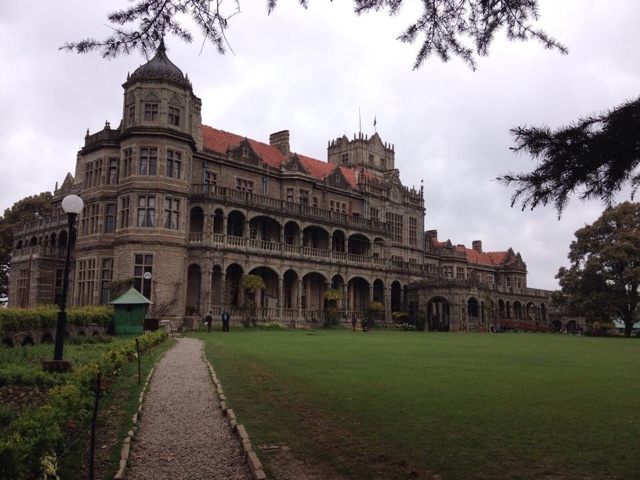
His son, Victor Bruce, also became Viceroy of India later, and he of course would be the cousin of the lady whose photograph adorns the living room wall in West Sussex. He was Viceroy at the time the photograph was taken in Shimla, most likely at the Viceregal Lodge, which we also visited.


The above images are of the Viceregal Lodge in Shimla, and Christ Church Shimla, the location of Victor Bruce's daughter's own wedding.

A little more digging revealed that my cousin's grandmother's future husband, Algernon George Durand was the military secretary to the Viceroy in 1894. They married back in London in 1895.

It is with all this information that it now appears this is how the two of them may have met, and the photograph on my cousin's wall is of her grandmother Elizabeth Marjorie Bruce, dressed in a ball gown, taken in Shimla in 1894, most likely while she was there visiting her own cousin the Viceroy. We toured the inside of the Viceregal Lodge and were able to see for ourselves the opulent ballroom that would possibly have been the location of the portrait at the beginning of this post.

As an unrelated matter, we also visited McLeod Ganj, the location of the Dalai Lama Temple, his holiness' residence in India while living in exile from Tibet. On our second day there we were lucky enough to meet the man himself. A very surreal experience.


Wednesday, 11 February 2015

Another Amazing Discovery.

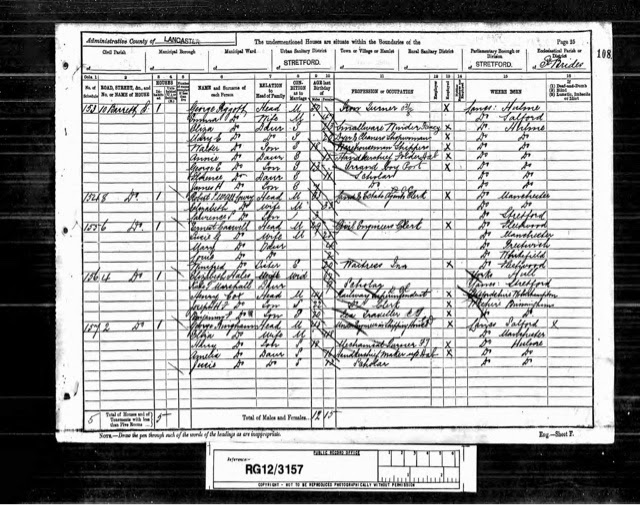
Whilst researching the address that my great grandfather was living at according to the 1891 census, aged 26, along with his 26 year old wife Hannah, and my newly born grandmother Doris, aged just one year, I made an astonishing discovery. They lived at number 62 Barrett Street Stretford. Here is the census page to prove it.


My great grandfather, William Terry Brookes was an accomplished landscape painter until his death in 1923. I own several original watercolours that are his work. He is of course the son of the more famous artist Warwick Brookes 1808-1882, who was famous for his pencil drawings of child life.

When I entered Barrett Street into a present day map search to try and find its location, the results that were returned were astonishing. Unbeknown to me at the time, also living on Barrett Street, Stretford in 1891 was another young family. They are listed at number 8, just a few doors down on the same side of the street, as Robert, aged 33, his wife Elizabeth, also 33 and Lawrence S, their 3 year old son.

Nothing unusual there? Well the surname of this other young family was Lowry. Yes, the famous Manchester artist, whose depictions of early 20th century working life in Salford by his painting of "matchstick men", (a term he would not like to be used) none other than LS Lowry, was born on the same street just a few doors down, and at the same time give or take two years, as my own grandmother. Here is the census page to prove it.


That opens up all sorts of possibilities. Lowry's biography states that he started drawing as a young boy, and his parents, recognising his interest, arranged for him to attend art school. He lists his inspiration as being the pre-Raphaelite artist Dante Gabriel Rossetti, who was a contemporary of my great great grandfather Warwick, and I have letters that were sent between the two of them in the 1870's.

Did the young Lowry ever watch my great grandfather WT Brookes painting his landscape watercolours as a boy, perhaps together with his young friend Doris, at the same time as listening to stories about the Manchester pre-Raphaelite movement and the artists of the previous generation that were part of it? We may never know. What a pity we only now have Internet access and the people we can link by using it are no longer around to ask.

Tuesday, 27 January 2015

Location Of Warwick Brookes' (1843-1929) First Studio

Here we have a photograph of Cathedral Steps, Victoria Terrace, Manchester, circa 1870's. To the right of the steps, a sign "Warwick Brookes" can be seen attached to the front wall of the building, above the first floor window. There appears to be furniture stacked around of the ground floor entrance.

We know that Cathedral Steps was the address of Warwick Brookes', (my 1st cousin 3X removed), first studio before he relocated to 350 Oxford Road for the remainder of his career. We also know that he married Mary Simpole, (Granny Brookes), and she was the daughter of Charles Simpole, a furniture dealer. A search of the business directories and censuses around that time shows that Charles Simpole occupied premises also at Cathedral Steps, (Cathedral Yard), and operated his furniture business from there.

Making an assumption from the detail within this photograph, it now appears to us, from this chance purchase from eBay today, this may well be how the two of them met, and the rest is history. They went on to have three children, also mentioned on this website - Warwick Brookes MP 1875-1935, Blanche Brookes 1872-1959, and Gordon Byron Brookes 1880-1916.

The photographer's cousin, also Warwick Brookes 1854-1922, (my great grandfather's brother), also ran his own photographic studio from Victoria Street, as did Le Chevalier Lafosse at various points around that time. The younger Brookes moved on to a studio in Marple Bridge, and Lafosse moved both his studio and home to Knolls House, Higher Broughton, Salford.

Although mounted on original card, and not marked on the front, I would like to think the image of his studio might have been taken by Brookes himself. Probably true - why would a photographer take an image of another's studio premises?

Manchester Cathedral and Victoria Terrace c1870's
Blanche's wedding, 8th August 1894. to Eugen Sandow, at Manchester Cathedral. Top left, Warwick MP, (brother), centre William Sinclair, (Archdeacon of London), 2nd right Florenz Ziegfeld Jnr. Right Eugen Sandow. Boy sitting below Blanche, centre, Gordon Byron, (brother). I am fairly certain that Blanche's father Warwick Brookes is far left, and her mother Mary is far right.

Saturday, 17 January 2015

The Letters Of Dante Gabriel Rossetti.

I have already referred to letters from Frederic Shields to Dante Gabriel Rossetti in other posts here. Shields wrote to Rossetti informing him of my great (X2) grandfather Warwick Brooks' poor health, which had forced him to give up his everyday work, and to rely on his artistic talents to support his young family. I now have access to two letters sent by Rossetti directly to Brookes as a result. Brookes was selling photographic representations of his art at £4 a set, and Rossetti wanted to acquire them. According to Letherbrow's biography, many eminent artists of the time acquired these sets of photographs, as well as museums, such as the South Kensington, now known as the V&A.

16 Cheyne Walk, Chelsea, London.
21st Feb 1868.

Dear Sir,

I lately saw a set of photographs from some admirable drawings from nature by you, and I understand from our friend Mr. Shields that a set can be obtained from you for £4. Will you therefor allow me to enclose that sum by P.O. order and to request that they be kindly sent to me at your convenience. I cannot doubt that, when seen they will quickly be appreciated in London by all whose judgement is of any value.

I cannot refrain, though a stranger, from saying how deeply I regret to hear of your present state of health, and how sincerely hope it may still change for the better; and with all best wishes, remain

yours sincerely,

D.G. Rossetti.

Another letter was sent to Brookes 7 days later:

16 Cheyne Walk, Chelsea, London.

My Dear Sir,

Many thanks for the beautiful portfolio of photographs which I value highly & which are already meeting with equal appreciation from others. The babies in particular, seem to me triumphs, every one of them; not that they are better than many of the other figures, but because every artist knows to his cost how difficult it is to attain such success in representing babyhood.

I do not know if you allow anyone to purchase fewer photos: than a complete set; but if you do, my brother is anxious to have about half the number, & in such case would send you word of his favorites among the series. With kind remembrance to Shields if you should see him.

I am your very truly,

D.G.Rossetti.


Monday, 22 September 2014

Educating For The Future.

Bolton School (Boys Division) Junior School 1965.
Education is an important part of any child's development, and parents who take sufficient interest in their children's education will often be rewarded by the satisfaction of bringing up well balanced adults that are able to cope with whatever the world has to offer them and to use every opportunity to their best advantage.

The Brookes side of the family often favoured Manchester Grammar School as the place for their children's education, although Gorden Byron Brookes attended William Hulme's Grammar School, and this year being the centenary of the start of World War 1, he features on their website on the page dedicated to Old Hulmeians who were killed in action in that conflict.

Our side of the family favoured Bolton School, an independent day school located on Chorley New Road, Bolton. That too celebrates anniversaries during 2015 / 2016. 2015 is the anniversary of the founding of the present school as a result of the generous donation by Lord Leverhulme. Then there is the 500 year celebration to mark the founding of the school itself. This is the page on the school website that will provide information on these events - 100 / 500 Celebrations.


My two brothers both attended Bolton School, as did two of my uncles, two of my cousins, and my own daughter. My own attendance was between 1961 and 1970, although I left at the age of 16. Personally I didn't enjoy school and couldn't wait to get out and start work! Above is the section of the above image that depicts me at the age of 11yrs. I am stood 4th pupil to the left of the teachers group as you view the photograph, with the "mop top" hair cut. Well it was 1965 in the midst of "Beatle mania"!


Monday, 10 March 2014

A Letter From Warwick Brookes The Artist

Contained within the April 1st 1871 edition of The Manchester Guardian is an article as follows:

Honours To A Manchester Artist, - We have repeatedly alluded with great pleasure to the beautiful drawings in pencil and pen and ink by Mr. Warwick Brookes of this City, of single figures and groups of children. They have been seen at various local exhibitions. Recently Mr. Gladstone saw some of these drawings at the residence of Sir Walter James, and borrowed them to show to the Princess Louise. The Princess, who is known to be an accomplished amateur artist, showed them to the Queen, who expressed a desire to purchase some of Mr. Brookes's drawings. Her Majesty has selected four, and characterized them as 'really charming'. The Queen has also without solicitation, directed that Mr. Warwick Brookes's name should be added to the Civil List for the amount of £100 per annum. Portfolios of photographs from his sketches have also been purchased for The Royal Academy and for The South Kensington Museum. We are glad that our able and modest fellow-citizen is being thus appreciated.

I have recently been lucky enough to find and acquire from a London dealer, an original letter from Warwick Brookes, artist, dated 8th April 1871. The letter is written by Brookes in the third person to one Miss Ida Rawlins, (who it appears had written to Brookes to request his autograph). Brookes explains that he is not the only Warwick Brookes in the district, but he has a nephew, also Warwick Brookes who is a photographer, but not much good at art. I can only imagine that Ida Rawlins had read the Manchester Guardian article on the 1st April, and as a result, had written to Brookes asking for his autograph, causing Brookes to reply on the 8th.

Funny how history comes together isn't it.

Sunday, 8 September 2013

Cowes Regatta, 5th August 1920

Detail taken from daily newspaper reports at the time, images from my own collection....

Britannia beaten in a great race - Cowes, Wednesday.

An image from within the family, originally taken by Beken of Cowes, marine photographers, I believe.

A fresh breeze blew from the north west all day today, and occasionally there were slight drops of rain, with some sunshine. Conditions generally were uncertain and variable, but not altogether distasteful to yachtsmen, however much they interfered with the social side of the regatta.
The King was early astir on the Victoria and Albert. He is playing an energetic part in the regatta, and has been aboard his cutter, Britannia every time she has stretched her wings. He was sailing on her again today, and had his companions The Duke of York, The Duke of Connaught, The Marquis de Soveral, The Marquis D'Hautpoul, and Admiral Brand. The Queen and Princess Mary had watched the racing from the Royal yacht, and at its conclusion in the early afternoon the Queen proceeded to Osborne House and Barton Manor, where she was joined by Princess Beatrice, returning to the Royal yacht for dinner.
There was a considerable exodus from the roadstead during the afternoon to see the eliminating trials for the international motor boat trophy in Osborne Bay.
The three events of outstanding importance during the day were a handicap for yachts exceeding 100 tons; and a handicap for racers exceeding 35 tons but not exceeding 100 tons; and a handicap for craft of 10 tons but not exceeding 35 tons. For the first of these three, a cup and other prizes were offered by The Royal Yacht Squadron, and the day's entries formed the biggest total of the week. The Queen's course over a distance of 44 miles was taken. Yesterday's event in which Britannia figured was over the same waterway, but only half the length was negotiated. Today, with improved conditions, the whole distance was covered. The entries were the King's cutter, Britannia, Mrs E.R Workman's cutter, Nyria, Mr Clarence C Hatry's schooner Westward, Mr Warwick Brookes' schooner Susanne, and Sir Charles C Allom's cutter White Heather II. Mr Richard A Lee's cutter Terpsichore was on the programme, but did not start, because in the contest yesterday her gear had been damaged, and there had not been time for repairs.

Susanne's Fine Performance.

It was a magnificent start. White Heather II was first away. The King's cutter followed closely on her stern, but had the advantage of being windward. Nyria got into third position and Susanne was last, closely in the wake of Westward. The canvas of all the craft was fully spread, and as they beat to the west yachtsmen were enthusiastic at the prospect of a brilliant struggle. The King's cutter was faced with a stiff bit of work on the handicapping, and in such company. She ran into first place, but was overhauled by Susanne, who not only saved her time, but beat Britannia on the handicap with 11 minutes to spare. Britannia was placed second. The first to cross the finishing mark was Westward, but she was third in the handicap. Westward is an American built schooner.
In the race for yachts not exceeding 100 tons the competitors were Mr C H Moller's cutter Paula III, Major Lionel de Rothschild's cutter Zinita, Mr J W Cooke's cutter Thanet, and Captain C W P Slade's yawl Joyette. Zinita finished first and Joyette second. The race for the 'baby' yachts not exceeding 35 tons fell to Mr J S Highfield's cutter Cyra. The only other starter was Mr G Mackenzie's cutter Patna.
The remaining seven events were for quite tiny boats, and when all were under weigh, the sight was noteworthy. Fifty seven boats had entered, and of these, a very large proportion were afloat. Seldom too, has there been so large a crowd of spectators even at Cowes, which in the past has been remarkable for its competitions for its small racers.
Tomorrow interest will be centred in the races for town prizes, amounting in value to £100, presented by the inhabitants of Cowes. His Majesty's Britannia will be a competitor.
The King had several guests to dinner on Victoria and Albert tonight. The evening turned out fine, and activity on the roadstead was considerable. Pinnaces were passing between the yachts till well after nightfall. The chief social event was a ball at the Trinity Parish Hall in aid of the Isle of Wight County Nursing Association and Trinity Parish charities. The function was promoted by Lady Godfrey Baring, and a number of other ladies of the island. Princess Beatrice, the president of the Association was present and there were visitors from both Royal yachts, the Victoria and Albert, and the Alexandra.

Left-right, Lord Hardwicke, Reginald Tyrell, Warwick Brookes, Major General Francis Lloyd
Hardwick and Lloyd were both involved in motor boat racing, while Brookes' interest lay in ocean yacht racing. Tyrell was a co-director and life-long friend of Brookes. Brookes also owned Westward briefly during the 1920's.

Thursday, 29 November 2012

Ledger of House Contents, 38 Park Lane 1919


View Larger Map


The residence marked 'A' on the Google Street view above is the present day 128 Park Lane, London. Back in 1908 this was number 38 Park Lane, but was officially re-numbered as 128 from 1934. This can be seen here: Survey of London Website, which also lists residents through history.

One resident was Mr. Warwick Brookes, (1875-1935), his wife Beatrice (nee Waldenstrom), and their children John and Claire. Amongst my Brookes memorabilia I have a gold leaf, leather bound ledger, which was prepared in December 1919 as an inventory of house contents by Messrs. Waring & Gillow Ltd., valuers, of 180 Oxford Street, London. The book lists each room, complete with all contents, and their value. The total value of contents can be seen below, which by present day standards is huge. Other interesting facts to emerge are the large number of servants employed, as can be seen from the list of the values of their possessions, and also the fact that the family obviously owned drawings by my grt grt grandfather, (Brookes' father's uncle), but didn't attach any great value to them, as they are all hung in the housekeeper's room, with individual values of around 10/- (50p).


The house is documented as being owned at this time by Sir Edward Mackay Edgar, a Canadian-British banker. He was a keen power boat racer and won the The Harmsworth Trophy in two consecutive years, 1912 and 1913 with his boat Maple Leaf IV. See also British International Harmsworth Trophy. The previously mentioned associate of Brookes, Lord Hardwick held a similar interest and owned his own boat Glisseuse, an 18 foot hydroplane, in 1910. I can only presume that the shared interest in boats and racing, (although Brookes' interest was in yacht racing), led to the association with Brookes, thus leading to him renting the property from Mackay Edgar. During the 1920's crash, Mackay Edgar shared the same fate as Brookes, - bankruptcy.


S.S. Borodino

A family portrait in oil, Warwick Brookes

During the early years of the 20th Century Warwick Brookes 1875-1935 became a successful and wealthy businessman as managing director of The Junior Army And Navy Stores, whose registered office was York House, 15 Regent Street, London S.W.1.

At the start of the Great War the company won the naval contract to supply His Majesty's Grand Fleet with stores and supplies, and a ship, the S.S Borodino, was made available to be used in this ambitious venture as a merchant fleet auxiliary. The contract ran between December 1914 and February 1919, and later, a book documenting the exploits of this ship was published on behalf of the company. The book can be read in full here: S.S.Borodino M.F.A Number 6.  and it contains many interesting photographic plates.

An Interesting Photograph

An interesting photograph has just been found amongst the family. Here it is:


There is a helpful caption hand written on the back which states: Lord Hardwicke, RT, Warwick Brookes, Major General Francis Lloyd.

Warwick Brookes is easy to identify, he is the one with the Panama hat. So, Lord Harwicke will be on the left. I presume RT next to him will be Brookes' lifelong friend Captain Reginald Tyrell, and the one with the moustache will then be Francis Lloyd. The family member who gave me this, Brookes' granddaughter, believes the location to be somewhere in Southern France, but if I was asked to guess, I would say Isle of Wight. By the gentlemen's attire the occasion is obviously linked to Brookes' hobby of ocean yacht racing, and the date? It is documented that Francis Lloyd was born 12th August 1853, and died 26th February 1926, so I would put the date of this image in the early 1920's. Warwick Brookes was managing director of The Junior Army and Navy Stores, who won a naval contract to supply the fleet during the 1914-18 war. Reginald Tyrell was also a director of that company.

The movie clip below is from testing Maple Leaf V for the race to be held at the 1920 Cowes Regatta, in which Brookes' yacht Susanne took part in its own class, and won against the King's yacht Britannia. The motor boats Maple Leaf V and Maple Leaf VI were owned by another friend, colleague and in fact landlord of Brookes - Sir Edward Mackay Edgar, a Canadian born banker, who owned the house on Park Lane, London, where Brookes lived at that time. Here is the story of the 1920 Harmsworth Trophy Race, held during Cowes Regatta week in that year: 1920 Harmsworth Trophy.


Major General Francis Lloyd had a distinguished military career, and during the First World War, was responsible for the defence of London, particularly from Zeppelin attack. More information can be found here: Major General Francis Lloyd.

There are several film clips of Lloyd during the 1914-1918 period in London. Here is one of them from 1917:

Wednesday, 9 May 2012

The amazing family of Warwick Brookes 1843-1929

This Warwick Brookes, was the photographer, who's business at 350 Oxford Road, Manchester was celebrated as being an establishment of quality within the profession, with clients from the upper classes and the theatrical world visiting from across the country. He was involved in photography from the early days, where the skills of a chemist were equally as important to those of an artist. He was the inventor of the Academy Camera, an early instrument, that was made in quantity by the Billcliff camera company. He was the cousin of my great grandfather William Terry Brookes.

He had three children, Blanche, Warwick and Gordon Byron. Each are the subject of their own pages on this website detailing their own exploits during their lives. Here though I will focus on the family of his son, also Warwick, who was born in 1875, and passed away in 1935 in Cowes, Isle of Wight, during Cowes Week.

Warwick Brookes MP
This is Warwick, a flamboyant businessman, who later was a business partner with his brother-in-law, Eugen Sandow. At the beginning of the Great War of 1914-1918, he established a factory for the manufacture of war equipment. He had become Managing Director of both the Junior Army and Navy Stores and of the Civil Service Co-Operative Society. When these two concerns were amalgamated, his holdings became so valuable that he received an offer for £250,000 for it, which he refused, but later, during the post-war slump, sold it for a tenth of that. In the 1916 election, he stood for parliament and was duly elected as a Coalition Unionist member for Mile End. His business career would see him immensely wealthy at times, and at others, on the brink of bankruptcy. His partnership with Eugen Sandow saw him managing Sandow's prestigious centres of physical culture in London. By 1932 he did appear in the bankruptcy courts, and by 1935, was dead, having travelled to Cowes on the Isle of Wight, with his daughter Claire, to watch the yacht racing, which he had held a lifetime interest.

Beatrice Brookes

Warwick was involved in a high profile divorce case around 1900. I have a detailed account of those events here: The scandal of divorce This is Beatrice, his future wife after that case.

Although her parents, Eric, who was Swedish, and Elizabeth Waldenstrom were living in Manchester, she was married to a Russian nobleman by the name of Emile De Minciaky, who had been an attaché at the Russian embassy in Stockholm, and London, but later worked at a copper rolling factory in Manchester. During her adulterous relationship with Brookes, a child was born, John Charles Hugo. He was christened De Minciaky, but in open court, during the divorce proceedings, both Beatrice and Warwick admitted that the child was theirs, and as a result of their relationship. Another child, Claire, was born in 1899, before the decree nisi was issued on the 20th March 1900. The decree absolute was issued on 4th October 1900. Brookes and Beatrice married in 1900 immediately after that. She passed away in 1926.
John went on to live his own amazing life as an officer in the South Lancashire Regiment (Prince of Wales Volunteers) during the first part of the Great War, and later, in the Irish Guards. He only found out about his past connections with De Minciaky when he was rummaging through his mother's papers at the age of 16, and discovered a family tree which detailed this.  After confronting his parents, he later referred to Warwick as his step-father. In 1925 he went to Downside Abbey, in Somerset where he became a Benedictine Monk, changing his name to Dom Rudesind Brookes. He later returned as chaplain to the army, attached to the Irish Guards, where he also took part in the second world war, being awarded the Military Cross for extreme gallantry during an action at Anzio. This is his citation for that:


CF 4th Class (Acting CF 3rd Class) Dom Rudesind BROOKES OSB 1st Bn Irish Guards.

Father Brookes has been the chaplain attached to the Bn ever since it came abroad. he has now served in both the Tunisian and Italian campaigns. In both these campaigns he has shown almost unbelievable devotion to duty and bravery. No wounded or dying man wherever he may be, has gone without Father Brookes' attention. he has been in places where the fire was impossibly heavy and yet he has given comfort to the dying without any thought for his own safety. During the last few weeks, in probably the fiercest fighting the British Army has yet seen, the priest moved through shot and shell never appearing too tired to go the furthest points to help a wounded man. He acted as the MO's assistant and on many occasions helped the stretcher bearers in their dangerous task of carrying men in. There are not words strong enough to describe the wonderful and shining example father Brookes gave to all ranks, and all the officers and men of this Battalion would give testimony to the tireless kindness, inspiration and help they all received from his hand. His personal bravery in addition to his priestly qualities gained him the admiration of all. The sight of Father Brookes pacing up and down reading his breviary under heavy fire has restored the confidence of many a shaken man.
     In recognition of this Chaplain's extreme gallantry and unsparing devotion to duty, I recommend he be awarded the Military Cross.

9th March 1944 
C.A. Montague-Douglas-Scott
Lieutenant Colonel
Officer Commanding 1st Bn Irish Guards

ADC to Lord Plumer, Malta 1921
* Ed's Note CF=Chaplain to the forces. CF 4th Class= Captain, 3rd Class=Major.
John's full birth title - according to his birth certificate is Count John Charles Hugo De Minceaky. He was awarded the OBE later in life.

Warwick's other child, his daughter Claire also born before Brookes and Beatrice were officially married, although, I believe was never admitted by her, had a very privileged early life alongside John and the rest of the family. They were brought up in the upper classes, and as is the norm in those circles had a nanny to look after them. Claire would also spend time living with her Aunt, Blanche, and her two children, Helen and Lorraine, whilst her husband Eugen Sandow was away performing his strong man act all over the world. As she entered her late teens, she enjoyed the trappings of that lifestyle, often mixing with her brother's officer colleagues at society parties and balls during the London season.

Claire Brookes
Claire married one Robertson (Roy) B Stewart, (her first husband), at a large society wedding at the Brompton Oratory in December 1920. They lived near to Warwick and Beatrice who still lived on Park Lane, London. They shared many a party outing together with her brother John, (who at this time had a bachelor flat on Mayfair), and her great friend Evelyn Laye, a well known actress of the time, see: Evilyn Laye . They would often go to Cowes, Isle of Wight, around the period of the early 1920's to take part in Cowes Week, where their father Warwick enjoyed success with his ocean going racer, Suzanne.


Claire passed away in 1983, a year before her brother John.

from "The Universe, 21st December 1984" Obituaries.

Dom Rudesind Brookes, OSB, OBE, Titular Abbot of Sherborne, who won the Military Cross while serving in Anzio, Italy, as a chaplain to the Irish Guards; at Downside Abbey, Bath, on Monday; aged 85.

He served as a subaltern with the Irish Guards in the First World War. His commanding officer who became a life long friend was the future Field Marshall Lord Alexander.

In 1921 he went as ADC to the Governor of Malta where he probably gained his vocation; because at the end of his training in 1925 he resigned his commission and entered the Benedictine novitiate at Downside.

In the Second World War he returned to his old regiment as chaplain and was with the Irish Guards in Tunisia and at Anzio where he won the M.C. for “extreme gallantry and devotion to duty.”

After the war he was parish priest of Beccles, Suffolk, before returning in 1956 to Malta as a chaplain and unofficial liaison officer between the Governor and the Archbishop at the time of the Mintoff dispute. While there he also became Headmaster of St. Edward’s College.

In 1966 he was appointed a titular abbot and went as Abbot Procuator to Rome where he remained for 11 years.

From "The Times 19th February 1985"

A requiem Mass for Chaplain the Right Rev. Dom Rudesind Brookes, OSB, Titular Abbot of Sherborne, late Irish Guards, will be celebrated at the Little Oratory, alongside the Brompton Oratory, at 5.30pm on Wednesday, February 27, by Dom Eric Phillips and Father Alastair Russell.

Much of the other information for this article has come from a 1983 biography of John's life, titled "Father Dolly, The Guardsman Monk". The author is Anthony Wheatley (son of Dennis). Although I believe it is now out of print, it is still widely available from used bookshops who advertise on the internet.

Monday, 6 June 2011

William Terry Brookes 1864-1923, location of last home address.

My great grandfather William Terry Brookes, was a landscape artist. At the time of his death in 1923, he and his wife Hannah were living at 8 Fisher Street, Old Trafford. He is buried in Stretford Cemetery.

Sunday, 5 June 2011

Warwick Brookes 1808-1882 location of last home address.

When Warwick Brookes 1808-1882, the artist died, it caused the publication of many articles in the press at the time. Amongst those was an account of his funeral which took place at Brooklands Cemetery, Sale. The article states that the cortège started from his home address at 4 Egerton Grove, Stretford New Road, joined Chester Road, and made its way to Brooklands.

Warwick Brookes MP and the scandal of divorce!

One of the newspaper cuttings I hold about Warwick Brookes 1875-1935, MP, relates to a divorce scandal, details of which appeared in the Times.


Emile de Minciaky had petitioned for the dissolution of his marriage to Beatrice, nee Waldenstrom, by reason of her adultery with Warwick Brookes.

Emile, born in Russia in 1870, married Beatrice on 27th August 1892 at the Brompton Oratory, <Click>, and from the age of 19 had been an attaché at the Russian Embassy in Stockholm, and later worked for a copper rolling company in Manchester. But by 1894 was manager of the London office of the National Cash Register Company.

Beatrice, born c1872, was the daughter of Eric Waldenstrom b1838 and Elizabeth b1848. Eric, born in Carlstad, Sweden, was in 1881 living at 9 The Avenue, Broughton, Salford, and working as a civil engineer*.

It transpired that a child, John Charles Hugo, had been born illegitimately during Brookes' relationship with Beatrice, and this was also reported in the divorce case. The decree nisi was issued on 20th March 1900, and the decree absolute on 4th October 1900. Beatrice and Warwick were married in 1900, sometime after that. There was another child, Claire, who was born c1899. Claire appears as an adult in later photographs of Warwick during his election campaigns, but there is never reference to the son John. Only Claire attended her father's funeral in 1935. The only other mention of a son, is in one of the obituaries to Warwick's brother Gordon Byron, who was killed in action on the Somme, where there is mention of another family member "serving on the front". That being the son of Warwick Brookes MP. I would assume therefore, that he possibly didn't survive the war.

(**May 2012, I now know that John did survive the war, having served in the 2nd/4th Battalion South Lancashire Regiment, (Prince of Wales Volunteers), having been commissioned on 30th June 1915 and assisted by his father Warwick's influence). On 15th February 1917 he was posted to France, and in May 1918 was hit in the head by shrapnel and transferred to Calais, his wound not serious enough to merit a return home. He returned to his Battalion on 22nd June. On 26th October 1918 he was commissioned in the Irish Guards in the 2nd Battalion. In 1925 he became a monk at Downside Abbey in Somerset, but returned to the Chaplaincy for the Irish Guards, in the second world war. As a novice monk his name was changed to Dom Rudesind Brookes. During active service at Anzio he won the Military Cross for extreme gallantry, and later in life was awarded the OBE. He became Abbot when he was appointed "procurator in curia" of the English Benedictine Congregation in Rome. In 1983, a year before his death, he narrated his biography to Anthony Wheatley, and this is published under the title "Father Dolly, The Guardsman Monk" which is still widely available from used book shops. Up until his 16th birthday he knew nothing of his past relating to his mother's previous marriage. He was then told that Warwick Brookes was in fact his step father, although, from the news report of the divorce which appeared in the Times, both Brookes and Beatrice De Minciaky admitted in open court that John was as a result of their union. The reason he didn't attend Warwick's funeral in 1935 is that he was out of contact abroad at the time).

In the above photograph, Claire, with the fur, is the lady on Warwick's left. The lady on his right, is his niece Lorraine Sandow. Claire was probably a teenager at the time of this photograph.

It was reported in the Times that Brookes and Beatrice subsequently lived maritalement in Bedford Court Mansions. Read about the area here:- http://www.bedfordcourtmansions.co.uk/
The 1901 census shows that Warwick, Beatrice, Claire (age 2), and John (Jack) Charles (age 3), were living at this address, (number 61), with one female servant.

*Eric Hugo Waldenstrom, although Swedish, lived in Salford, and is listed as a civil engineer. He is also believed to be an inventor, perhaps of a modified Davy miner's lamp, known as the Waldenstrom patent. This modification ensured the lamp was extinguished before it was opened, and was demonstrated by a member of the Manchester Geological Society, (Mr. Horsfell), at a meeting held at The Peter Street museum in May 1867. Whether the design is the work of Eric Waldenstrom remains unproven, however, another patent, for improvements in machinery involved in the production of bolts, rivets and spikes can be shown to be linked to Eric Hugo Waldenstrom in the following link. There is reference to him, again in an on line readable book, which lists alphabetically the people who registered or applied for patents of invention in the middle years of the 19th century. <Click>.

This is the modern location of The Avenue, Salford, which is the same as it was then, but changed beyond recognition by the type of property that is there now.


View Larger Map

At the time the Waldenstrom's lived here, The Avenue was tree lined, with a few terraced villas along the road, and although 40 years prior, was surrounded by parkland, was now beginning to be built up with additional terraced streets and factories surrounding it. In the 50's and 60's, the whole area was demolished and replaced with modern local authority housing.

Friday, 3 June 2011

John Henry Letherbrow

Again, not related to the Brookes family, John Henry Letherbrow was the brother of Thomas Letherbrow, the lifelong friend of my grt grt grandfather Warwick Brookes 1808-1882. I mentioned him in my article on Thomas, and stated that John was an artist of great promise, and had studied at the Munich Academy of Fine Art. Unfortunately, he passed away at the age of 47, in Munich, before his promise as a great artist had been fully recognised. It was fashionable for artists of that time to attend art colleges in Germany, as they were seen to be the premier establishments where the skills of the artist could be polished to perfection.

This depicts a piece of his work:-

The story of Endymion "What is it" by J. H. Letherbrow.


John Henry Letherbrow died on 8th November 1883 at Krankenhaus, (German for hospital), Sendlinger Tor, Munich, Bavaria, (now the location of Munich University). His will was proved on 10th January 1884, being shown as late of 5 Grove Street, Ardwick, Manchester. (This address no longer exists, the area having been extensively re-developed). The will was proved at the principle registry by John Cunliffe, of Lumber Hey, (possibly Lomber Hey), near Stockport, Cheshire, (now a suburb of Manchester), then in the county of Chester. Commission agent was Thomas Letherbrow, of Cavendish Villa, Davenport, Stockport, brother and executor. Thomas Letherbrow's main occupation, for the whole of his life was at Messrs. Cunliffe Brooks and Co., a bank, where he eventually became chief cashier. I am presuming that the Cunliffe linked to the will, was something to do with the bank where he was employed.

Monday, 30 May 2011

Gordon Byron Brookes, killed in action.

Captain Gordon Byron Brookes 1880-1916, son of Warwick Brookes 1843-1929, the photographer of 350 Oxford Road, Manchester, was killed in action during the Battles of the Somme, in 1916. The action is detailed in the archives of the Duke of Cornwall's Light Infantry, and is as follows........

Friday, 27 May 2011

Coincidences during historic research.

For the amateur, who is perhaps researching historic data for the first time, perhaps attempting to discover their family history, there will be times when you stumble upon information which seems too good to be true. It often is!